
Why we exist, and the change we work toward
Disabled people are still routinely excluded from the careers shaping our future. We are building the pathway that changes that.
The problem, in numbers
of disabled people in the UK are in work, against 81.9% of non-disabled people: a 27.5-point gap.
UK Parliament Research Briefing, May 2024less is what disabled workers earn on average than their non-disabled peers.
ONS Disability Pay Gap, 2023is what drones alone are projected to add to the UK economy by 2030, creating over 628,000 jobs.
PwC UK Drone ReportThe industries we work in are crying out for talent while capable people sit excluded. Most support programmes accommodate rather than empower: they focus on access, not ambition. That is the gap the Foundation was built to close.
Our theory of change
Read it left to right, the same way it appears in our published theory of change: who we focus on, what we are doing, what that ensures, what it is a pre-condition for, and what it culminates in.
Focus area
PillarsDisabled individuals & communities
Employers & industries
Policy makers & system leaders
Doing this…
Intervention strategiesDisabled individuals & communities
Specialist technology & digital skills training
Future-facing career discovery & experience pathways
Integrated health & rehabilitation support
Self-employment & enterprise pathways
Fieldwork & community projects
Employers & industries
Coaching & consultancy on inclusive recruitment & innovation
Recruitment culture change & capability building
Lived experience insight & co-design
Partnership development & network building
Policy makers & system leaders
Narrative-shifting campaigns & storytelling
Research, data & insight generation
Strategic working groups & policy engagement
Ensures…
Intermediate-level outcomesConfidence, skills & self-sufficiency
People build confidence, self-direction and capability, supporting independence.
Health & career sustainability
Participation in work and learning is sustained, with support for recovery and fluctuating capacity.
Adaptive catalyst work & progression
People engage in purpose-driven roles that align with their values and capacities.
High-growth sector access & participation
Disabled people access geospatial, environmental and technology fields on equitable terms.
Representation & belonging
Disabled people are visibly present, valued and connected across roles and leadership.
Inclusive practice & social and environmental innovation
Inclusive approaches are embedded across policies, systems and culture.
Cross-sector alignment & ecosystem strength
Partnerships and networks support shared learning and coordinated progress.
Social impact & sector contribution
Disabled people shape innovation, sustainability and progress through their work.
Which is a pre-condition for…
High-level outcomesSelf-directed lives & careers
People live and work on their own terms, with the freedom to define their purpose and contribution.
Society built for human difference
Social, cultural and civic life recognises the full spectrum of bodies, minds and ways of being.
Representative leadership across industry
Leadership in emerging industries reflects the full diversity of human experience.
Lived experience at the heart of system change
Public systems, employment and innovation are grounded in lived experience.
Which culminates in…
ChangeA sustainable future that belongs to all of us.
Measured, not claimed
We assess every participant before, during and after the programme: employment situation, wellbeing, skills and confidence. Every impact figure we report traces back to a real, measured change in a real person's life, aligned to the National TOMs framework and the UN Sustainable Development Goals.
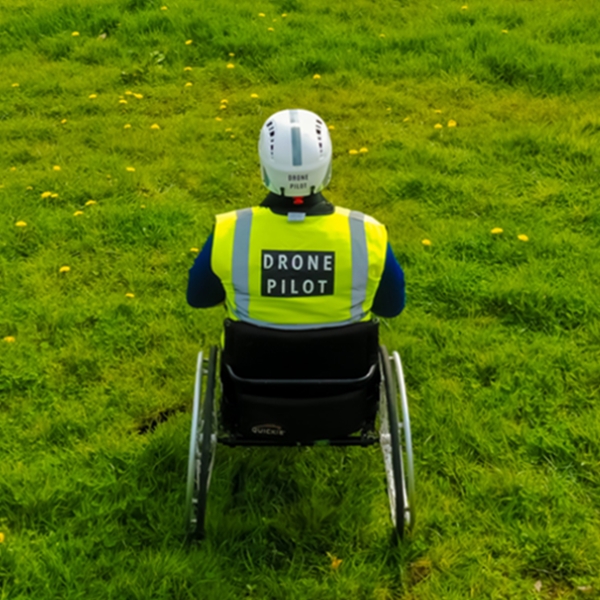
Our work is designed to prove a point: disabled people can deliver professional survey work in the most demanding and inaccessible environments, in the UK and beyond.
Help us scale the change
Partner with the Foundation or support the programme directly.